Forms convert badly for a boring reason: they demand commitment before delivering any value. Seven fields, a submit button, and a promise that someone will "be in touch." A lead generation chatbot flips the order. It answers the visitor's question first, then asks whether they want to take it further, and that one inversion is most of what there is to know. The rest is timing and restraint. I read widget transcripts for a living (Customer & Sales is the polite title for it), and the difference between a captured lead and a closed tab is rarely the script. It is when the ask arrives.
How the category poisoned its own well
You have met the bad version. Four patterns did most of the damage.
The instant email gate. "Before we start, what's your email?" is a form wearing a chat costume, and it converts like one. The visitor has received nothing yet, so there is nothing to reciprocate.
The fake human. A headshot, a first name, a "typing" animation, and no person anywhere behind it. Disclosure is basic ethics, and in some places the law. It is also self-interest: the moment a visitor catches the pretense, the conversation is over and the deal usually goes with it.
The arrival ambush. Auto-open, a sound, and a bouncing badge two seconds after page load, while the visitor is still reading your headline. Interruption before interest reads as desperation.
The black hole. The bot collects an email, answers nothing, and nobody follows up. This one is worse than having no chatbot at all, because it took something and gave nothing back.
These patterns persist because they demo well. Raw lead counts go up, the dashboard looks brilliant, and the damage (visitors who now reflexively close every chat widget they see) never appears in the report that justified them.
The bar, in other words, is low. Clearing it takes one principle and a few rules of restraint.
Answer first, then ask
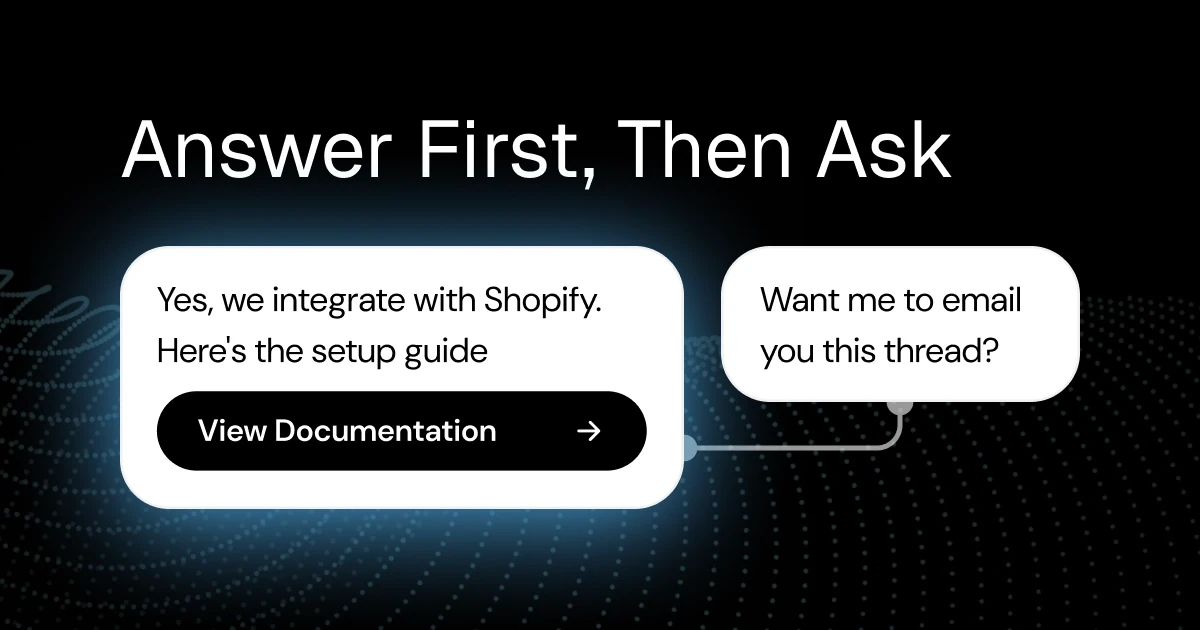
The principle: capture rides on delivered value. A visitor asks "do you integrate with Shopify," the bot answers properly (with the actual doc link), and then makes an offer worth an email: "Want me to send you this thread?" or "Want a walkthrough on your setup?" Same fields as the form, completely different feeling, because the conversation earned the ask.
It works outside software too. A visitor asks a bookkeeping firm's bot whether it handles year-end filings for small companies; the bot explains the service and the rough timeline, then offers a callback slot. The visitor got an answer the page alone would not have given them, so handing over a phone number feels proportionate instead of premature.
The offer itself should name a concrete deliverable. "Want me to send you this thread?" beats "want to stay in touch?" because the visitor knows exactly what will show up and why it is worth an address.
This changes the welcome message too. If capture is part of the plan, say so up front, the way the agency example in our welcome messages post does: "if it sounds like a fit, I'll offer to set up a call. No forms." A declared ask lands as a promise kept instead of an ambush. And timing beats scripting by a wide margin: the same sentence ("want me to set up a quick call?") is pushy at message one and natural at message four, after two real answers. If you tune one thing this quarter, tune when, not what.
Qualify by being useful
Progressive capture beats interrogation. Ask for a name and an email when there is a reason to have them, and stop there. Every extra field costs completions, and your team can ask the rest on the call anyway.
What counts as a reason: an email when the visitor asked for something that gets sent (a thread, a quote, a document), a name when a person will actually use it, a phone number almost never in chat. Any field the next step does not require is drag, and the visitor can tell which fields those are faster than you can.
The better trick is qualifying questions that also serve the visitor. "Roughly how many orders a month?" sounds like qualification, and it is, but it also changes the answer the bot should give: which plan fits, whether they need the API, which integration matters. Ask questions that improve your answer, and the scoring comes along for free. Visitors can feel the difference between being helped and being graded.
For stores, this pairs naturally with catalog and order questions; the ecommerce chatbot guide covers that question mix in detail.
Triggers that work, and the restraint that keeps them working
Where the offer fires matters as much as how it is worded. Four triggers show up again and again in transcripts that end well.
Pricing page dwell. Someone who has been reading your pricing for a minute has a question. A quiet prompt ("want me to check which plan covers your volume?") meets a decision already in progress.
The second visit. A returning visitor moved from research to consideration on their own. That is the moment an offer to talk is a service rather than a pitch.
High-intent questions. "Do you integrate with X," "how does onboarding work," and "can I migrate from Y" are hand-raises. The bot should answer the question, then offer the call.
Exit intent on a high-stakes page. One last "want me to email you what we covered?" is fine. Once.
Start with one trigger on one page and read what happens for a week before adding the next. Stacked triggers are how well-meaning setups drift back into ambush territory, one reasonable-sounding rule at a time.
The restraint rules hold the whole thing together: one capture attempt per session, never mid-answer, and never on checkout or docs, where the visitor is already doing the thing you want. The tradeoff deserves naming. Restraint costs you leads. It returns a shorter list your sales side genuinely wants to call, and that trade wins everywhere except the vanity chart.
Route leads where someone actually looks
A lead that lands in an unwatched dashboard is a form submission with extra steps. Decide the destination before you switch capture on: a shared inbox that one person owns, a Slack alert for the hot ones, or your CRM. Hey Support drops leads into the inbox with the full conversation attached, can ping a Slack channel, and syncs outward through Zapier; a HubSpot lookup can pull the contact's existing history into the thread so sales starts with context.
Whatever the destination, one person owns it. Shared responsibility for lead replies means a rotation with names on it, because "someone will see it" is how leads quietly age into apologies.
Then protect the reply. My opinion, after reading a lot of these threads: reply speed matters more than capture rate. A warm question cools by the hour, and yesterday's hot lead answers today's email like a stranger. If you cannot reply the same day, at least send the honest version ("thanks, a proper reply is coming tomorrow morning") from a person, not a noreply address.
The math here is unkind. Say the bot captures forty leads a month and replies go out four days later; most of those conversations have moved on, and the capture work was wasted upstream of the reply. Half as many leads answered within the hour would beat all of them answered on Thursday.
Measure the pair, not the count
Raw lead count rewards every dark pattern above, so keep two numbers instead.
Leads per 100 conversations tells you whether the capture moments are working, without crediting sheer traffic.
Reply-worthiness is the one almost nobody tracks: of your last 20 leads, how many did your team actually want to reply to? If sales shrugs at half the list, the bot is asking too early, and the fix is moving the ask later, not adding fields.
Close the loop on what happened next. A simple monthly tally (replied to, meeting booked, went quiet) says more about capture quality than any in-chat number, and it keeps the incentive pointed at revenue rather than at a counter. If leads are plentiful but meetings are rare, the bot is winning the wrong moment, and the fix lives back in the trigger list above.
Lead capture done politely is just good service with a memory. Answer the question, offer the next step, remember who asked for it, and reply like you wanted the lead in the first place. The use cases page shows how different kinds of teams wire this up; if you would rather just try it on your own traffic, the free plan covers 50 conversations a month, which is plenty to find out whether your visitors take the offer.