The AI chatbot vs rule-based chatbot question usually arrives framed as old versus new, which is the wrong frame. These are different tools with different failure modes, and the honest comparison is less flattering to both sides than either camp admits. I have designed conversations for both kinds. Here is where each genuinely wins, the dead end nobody puts on a pricing page, and why most teams quietly end up running a hybrid.
What each one actually is
A rule-based chatbot is a decision tree you author by hand. Buttons, menus, keyword matches. The visitor walks a flowchart you drew, and every message they see is a message someone on your team wrote. It is deterministic: same path, same words, every single time. When it works it feels like a vending machine: press B4, receive policy.
An AI chatbot, as the term is used in 2026, is a language model that reads the visitor's message, plus, in any serious setup, retrieval over your own content so answers come from your pages instead of the model's memory of the internet. It is probabilistic: it can understand nearly anything, and it guarantees nothing verbatim.
Plenty of products sold as AI over the past decade were trees with a thesaurus, which is part of why the terms feel muddy. The distinction that matters sits underneath the marketing: who does the understanding, a flowchart or a model.
Neither description is an insult. Deterministic and probabilistic are both useful properties. The question is where you want each one.
Where rule-based chatbots genuinely win
Exact wording. If a disclosure has to be delivered word for word, compliance text, cancellation terms, anything a lawyer signed off on, a tree delivers it word for word, forever. A language model paraphrases, and paraphrase is drift.
Structured intake. Five fields collected in a fixed order is a form wearing a chat costume, and that is fine. Trees are good at forms.
Zero-surprise requirements. Some businesses cannot absorb even a small rate of surprising output. If a wrong word costs real money or a license, deterministic wins by default, and no amount of model quality changes that calculus. Think pharmacy intake or insurance disclosures, anywhere the sentence itself was approved by someone with a title.
Nothing to retrieve. If your documentation is three paragraphs and a phone number, an AI bot has almost nothing to stand on. A small tree covering your five real questions can be built in an afternoon. Writing the content pays off twice though, once for the bot and once for the humans who read it, so I would still start there.
Where AI chatbots win
The long tail. Visitors phrase one question a hundred ways. "Where is my order", "package never came", "tracking says delivered but no", plus typos, plus Swedish. A tree handles the phrasings you predicted. A model does not care how the question is spelled. In practice this is most of the argument: for any business with real traffic, the long tail is the bulk of what visitors type, and it is exactly the part a tree cannot see coming.
Content-heavy businesses. If you have real documentation, policies, or a catalog, retrieval turns it into answers directly. The decision-tree version of a 200-page help center is a project nobody finishes.
Languages. A model detects the visitor's language and answers in it. With trees, every language is another whole tree to build, translate, and keep in sync. Nobody keeps them in sync.
Maintenance. This one is the sleeper. With a tree, every policy change is an editing session in a flow builder, hunting the forty nodes that mention shipping. With retrieval, you update the page and the bot follows. The content team you already have becomes the bot team without noticing.
The dead end nobody advertises
Tree bots share one failure mode: the first sentence you did not predict lands on "Sorry, I didn't understand that. Please choose an option."
Visitors learn the lesson in one attempt. This thing cannot help me. They stop trying, on your site and, a little, on every site. The damage is also invisible where you would look for it: no ticket gets created, so the dashboard logs a quiet, successful-looking session while the customer leaves with nothing. You often pay for the failure twice: the visitor who gave up on the widget writes an email anyway, now slightly annoyed, and the bot that was meant to shrink the queue added a step in front of it.
The real answer is a hybrid
Understanding is probabilistic. Actions should not be.
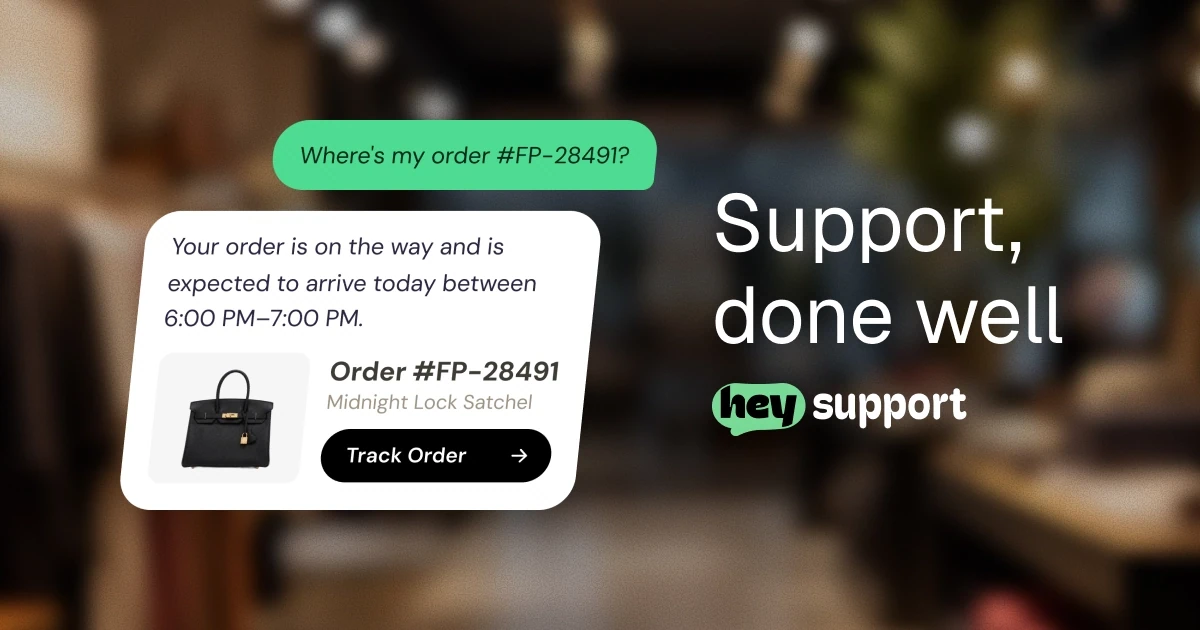
The setup that works, and the way modern platforms including Hey Support are built: the AI handles comprehension and answering, grounded in your content. Deterministic tools handle everything with side effects: booking a slot, capturing a lead, looking up an order in your store, handing off to a human. The model decides which tool fits the request; the tool then does the thing exactly, the same way every time. When the bot books a meeting you want a widget with real time slots, and creative writing is nowhere in that transaction. The same shape covers an order question end to end: the model understands "my package never came", the lookup tool fetches the real order status, and the model writes the reply around real data instead of improvising one.
Rules still exist in this setup, just wearing a different job. They act as guardrails: topic boundaries the bot will not cross, refusal thresholds for when retrieval comes back thin, and approval gates where a human confirms sensitive actions, a discount code above a limit, say, before anything goes out.
You get the tree's precision exactly where precision matters, without asking the tree to do the listening.
Six questions that decide it
Run through these honestly and the architecture mostly picks itself.
- Do you have real content? Docs, policies, FAQs. Yes means an AI bot has something to stand on. No means build a small tree, or better, write the content first.
- Must some answers be word for word? Keep those flows deterministic, whatever else you do.
- More than one language? AI, unless you enjoy gardening four trees.
- Is your question mix five FAQs or a long tail? Honestly five FAQs: a tree or even a good FAQ page might be enough. A long tail: AI.
- Do you need actions, like booking or order lookup? That is hybrid territory by definition: AI to understand, tools to execute.
- Who maintains it? A content team that already updates pages favors AI. Nobody at all favors neither; an unmaintained bot of either kind goes stale, just differently.
For the wider rollout picture, cost, timeline, risks, there is a plain-English guide to AI customer support, and the operational rules live in chatbot best practices.
Side by side
| Rule-based | AI with retrieval | |
|---|---|---|
| Setup effort | Author every branch by hand; quick for one flow, slow for coverage | Point it at content you already have; review what gets indexed |
| Maintenance | Edit the tree every time anything changes | Update the content; answers follow |
| Long-tail coverage | Only the phrasings you predicted | Handles wordings you never wrote down |
| Wording control | Total; every message is authored | High when grounded; never verbatim |
| Languages | One tree per language | Detects and answers in the visitor's language |
| Failure mode | "I didn't understand" dead ends | A wrong answer, if built without grounding and refusals |
If you are starting today with real content behind you, start with AI plus retrieval, wire deterministic tools for the actions, and script the handful of flows where wording is law. That combination is what both camps were slowly converging on anyway: tree products kept adding intent detection, AI platforms kept adding buttons and forms, and everyone was headed to the same place. The tools and guardrails we ship are on the features page, and the Free plan's 50 conversations a month are enough to find out which questions your visitors actually ask. Start there.